Showing posts with label Math. Show all posts

Thursday, June 27, 2013

Building Mathematical Comprehension–Chapter 4

Chapter 4

Increasing Comprehension By Asking Questions

I am one of the bloggers hosting! So excited!

I guess this post is more of a reflection on the specific topics/concepts the author develops.  Since I am moving to a new grade, I am rethinking how I teach math and how to apply some of these ideas in second grade.

I was really interested in this chapter because my district advocates for an Inquiry Based Teaching Method.  However, I am finding, at least at this point with the CORE Standards and a new math series, we are not as focused on inquiry .  In the last year we have really implemented the CORE full time and the focus was overwhelmingly on building basic fact fluency and content skills. In the long run, I think my students struggled with applying content to problem solving requirements on the state test.  I know that I want to work more on applying the content next year.

We \split our students across the grad level into more heterogeneous classes fro math and we have 55 minutes a day.  It has drastically changed the way I teach because I only have these students for 55 minutes and most of them are not in my homeroom. It puts a lot of pressure on to use the time wisely and efficiently.  It does not promote inquiry based teaching and that is really disappointing to me. I think some of the ideas in this book will really help me to make math more connected to the rest of the day for the kids, despite the fact that we form different classes for this subject.

Here are the concepts presented and my reflections:

Math as a Social Process

On page 119, Laney Sammons refers to math as a “social process”.  I guess I have never seen math as a social process. I think I do need to have my students interact with each other more frequently during math.  Maybe next year, since I  will not be in a testing grade, I will be able to have a little bit of freedom to mix it up.

Asking questions before, during, and after working with a math problem. 

Of course I think of this in reading, but not in math.  It refines what I had been trying to do with my students this year and will help me support my students in developing thinking skills in math with more consistency. 

Asking Questions Before Working to:

  • Activate Prior Knowledge
  • Develop problem solving strategies

Asking Questions During Working to:

  • Determining missing information

Asking Questions After Working:

  • Determining if an answer makes sense
  • If the problem has been solved

Reasons to Ask Questions in Math

I like the idea of brainstorming reasons for asking questions during math – page121-124. This would be a great chart to kick of the year in math next year.

QAR

I also love the QAR reference! I think this would be really helpful to teach students for supporting problem solving, especially when approaching word problems.

Right There:

  • Conceptual Questions - Using resources
  • Problem-solving Questions - Information from the problem

Think and Search

  • Reasons for using/learning concept
  • Gathering information to solve the problem.

On my own

  • How to use in real life
  • Determining strategies and if a solution works

Thick an Thin Questions

Quick answer versus “Why” questions - I think teaching students the difference between computation type questions and more concept based questions would be really helpful.  This would also help students to make more connections between what they are learning and to reflect on their thinking when problem solving.

Strategy Sessions

The idea of teaching small groups was a goal of my last year, but I never felt like I had the time. This will be a goal for me next year.

Wonder Walls

I use this idea in the other content areas, but need to open up my thinking to use it in math.  I can see having a wonder wall and giving my students post-its to add as class ends.

"What’s the Question"

Again, another great idea!  I think that teaching students how to create questions given a specific set of ideas or perimeters would really support test-taking skills.  If they learn to be in control of creating questions to answer, the kids may better understand how to approach a question on an assessment.

I created a little freebie with 2 general posters, 2 strategy posters, and student bookmarks.  I think they will be helpful for my students next year.  Leap on over to my Teachers Pay Teachers site for your download!

imageimage

imageimageimage

Check out my co-hosts at these lovely blogs!

Curls and a Smile

Also – don’t forget to follow on Bloglovin’! Click below to follow!Follow on Bloglovin

Sunday, January 27, 2013

Multiplication Raps!

I think I may have found a way to help my students learn their multiplication tables AND have some fun! For some reason, it has been really tricky to develop fact fluency and I have tried so many ideas.  I found a great YouTube Channel that has raps for each of the tables. So, every day my students come into the room (we have leveled math groups and all of the students switch classrooms for math) we listen/watch one of the videos. They are from Kiboomu and have three stages:

  1. Chanting each fact in the table with the answer.
  2. Chanting each fact in the table without the answer.
  3. Mixing up the facts without the answer – so the students have to respond.

They have many more educational videos too! Check out the station!

image

My kiddos are loving this and it gets them moving and thinking first thing in the morning!

Tuesday, June 12, 2012

Guided Math

I am joining in the Guided Math Book Study at Primarily Inspired


My professional goals this year centered around math and I have written a ton of curriculum for my current grade level.  However, with my move to third grade, I’m not sure what this is going to look like.  I know that we have a 60 minute period and we switch students, so the groups are more heterogeneous. I can’t see that doing whole group lessons everyday would work well, but I’m not sure what it will look like, or how much choice I will have.  I also want to make sure that I have some math connections in my own classroom, with my full class of students.  Here are my thoughts so far:

Key Components In This Model:

1. A Classroom Environment of Numeracy

I like the idea of having a math board in my classroom, both for my math group and my homeroom.  I can see having the current vocabulary up and maybe having some challenge problems for early finishers.

2. Morning Math Warm ups and Calendar Board Activities

I would like to do something with morning work, to stay connected to my students who may not be in my math class.  When I student taught in second grade, the kids had a calendar and there was a math problem of the day posted for them to solve.  I also like the idea of having a math journal.  I just need to get into the routine before I can figure out how that might work with a math class comprised of students from several classrooms and not knowing what level I will be teaching.

3. Whole-Class Instruction

We currently use a textbook resource.  It has a HUGE workbook for the kids.  I have to say, I was not married to it in first grade.  It was nice to have the resource there and ready to go, but I am not a workbook person and I found myself teaching with worksheets.  That may be a method as I start a new grade level, but I am hoping my structure will be more mini-lesson based with activities and guided groupings.

4. Guided Math Instruction with Small Groups  of Students

Again, with an hour of instruction, I think a center-based format would be a great way to use that time well.  I have been a big Daily 5 advocate for years and have applied that model to math with my first graders.  I can see having similar stations in 3rd.

I saw a great idea somewhere where a teacher would circulate during a whole group activity and move color magnets with students numbers on the board as it was observed that they might need extra support.  The support group was formed quickly and easily.

5. Math Workshops/Math Stations

Here is what I am thinking for centers: Math Facts, Computer, Hands-On Games, Teacher Center

I found this great resource (I actually used the addition and subtraction version this year):

It provides great games and literacy connections.  I can’t wait until it arrives in the mail!

Routines to develop:

  • Rules for using with manipulatives and where to get them independently
  • What to do if you finish early.
  • What to do if there is a question.
  • Where to store materials.
  • What to do when you come to math class.
  • How to clean up materials.

6. Individual Conferences

I would really like to do this!  I think student reflection is critical and I am curious about how it works when I don’t have my own students.  I found this to be hard when I taught fourth grade because I didn’t really get to know my students as well.  I only had 4 of them in my homeroom.  See my idea for this in the next section.

7. An Ongoing System of Assessments

I know this will be critical because of the structure of switching classes.  I am automatically thinking of using a sheet I really felt was successful for reading and writing.  I would write what I observed and then write my teaching/conference point.  I think I will have these copied on a bright colored paper and have a clipboard for math class.  I know organization is going to be key when switch classes.  At least I can stay in my classroom, unlike the last time. When I taught fourth grade, I was a travelling math teacher and had to go teach in another wing of the school and cart all my materials with me…fun!

I will link up my conference form tomorrow.  Google Doc is giving me fits and I can’t do much on my iPad.
 

I was lucky that Amazon had the first chapter of this book for preview.  I hope my order from Amazon comes in soon so that I can keep up with the reading!

Wednesday, May 30, 2012

Money, Money, Money

Can you here the song?  We are working on a very short money unit in my class.  The kids are required to know the names and values of the 4 basic coins.  That is a huge step back in our curriculum.  The advantage it that the kids will REALLY know their coins before they learn how to count money.  That was always a really tough skill in first grade!  Here are some of the great resources I have been using:


Harry Kindergarten’s Money Videos on YouTube:

Thumbnail  Thumbnail

Thumbnail  Thumbnail

Cara Carroll’s “The Great Coin Collection” from TPT – amazing activities ready to turn into centers!  Also provides for great differentiation!


Harcourt Publishers also have a great site for games!  These are wonderful to incorporate into centers.  Each of our student computers has Active Board, the Promethean Board software loaded, so I can make charts with a screen shot of the game and link directly to it.  I can lock everything is so that it is a great work board during centers!

image 

Every New Beginning is having a Target card giveaway!  Click on the image to go to her blog and get details on the giveaway!  


Happy almost June!


Sunday, January 8, 2012

A Few Random Things

First, is anyone out there in blogging land from NY?  I would love to get together with other blogger from Western NY.

Secondly, I thought I would share how I organize some of my math materials.  My goal is always to give students access to all materials and have them do prep work.  I am not a fan of prepping things unless I have to.

I store all of my manipulatives in a shelf like the one in the middle in the picture below.  I REALLY disliked the primary color bins.  When I inherited the shelf from another teacher, they had seen better days and I just did not like how they looked.  I bought  Sterlite shoeboxes to store manipulatives in and made labels for the boxes.  It looks all matchy-matchy and very clean now.

Then I made a few systems for the students to get all of their own pieces to play center games.  Again, I bought a Sterlite drawer container – I swear I must keep this company in business! I store dice and game pieces in the top drawer.  The game pieces are in little container I bought at the dollar store and are actually little erasers.  You can buy containers of them – like 100 in a container.  They make great game pieces because students have enough markers to play any game.

P1010287  P1010288

I the bottom drawers, I store cups I rescued from a teacher who was throwing them away.  I put about 20 counters in each cup to be used as manipulatives.

P1010289    P1010290

This system allows students to get whatever they need when ever they need.  Saves boatloads of time!

Thirdly, I am getting ready for Valentine’s Day!  I wanted to send home a project for students to make their own containers.  I usually do them at school, but need all the time I can get for academics this year and wanted to have the students do another project with their families. Snag a copy of my letter and a graph by clicking on the image.

image

Have a great Monday!

Monday, October 17, 2011

Virtual Manipulative Resources

Love2Learn2Day is having Math Monday Blog Hop #28. Click on the button to check out the great resources!

I was excited about math this year because I spent so much time writing curriculum last year and read these two great books:

image     image 

I wanted to work through some of the new concepts in our curriculum through the use of our Promethean Board.  I found 2 great sites with virtual manipulatives.  Check them out to see if they are helpful to you.

The first is from the National Library of Virtual Manipulatives.  It wasn’t exactly what I was looking for, but had some neat features.

image

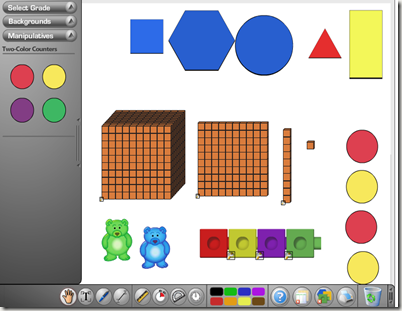
The site below is fantastic.  It is through McGraw-Hill and you can change to all sorts of manipulatives. I took a screen shot of some that I tried.  Love it!  I think this will really help me out.

image

Some how, despite all of my excitement and new understandings, I have just gotten a bit stuck teaching math this year.  We have a new series: GoMath.  It is great, but I am just having a hard time working with a textbook.  It is the first time our students have worked with a textbook of any kind.  We used to start with patterns and graphing and now begin with adding and subtracting.  HUGE difference.  I am also finding that my little ones who are still working on kindergarten concepts are not eased into the first grade material anymore.  They are dumped into adding and subtracting. 

I think next year will be much better, but teaching math is a challenge right now.  I’ll keep plugging away and trying to make heads or tails of the new and different concepts I am teaching.  I hope to have some great things to share as my brain gets wrapped around the new curriculum and all of my new resources.

Wednesday, September 21, 2011

Math Centers

We have started Daily Math in my classroom.  I started experimenting with the math version of the Daily 5 last year and intended on implementing it more regularly this year.  We have developed our rules for Daily Math and charted it.  I need to make a pretty version of it to share, but I wanted to get my thoughts out. 

As an aside, I am amazed at the amazing teachers who blog during the year.  I keep thinking of things I want to add to the blog during the day, but then I get caught up in the whirlwind of the day and forget when I am wiped out at the end of the day!

I have 5 centers with a mix of number writing, number identification, and number comparison activities. 

Center 1: reviewing formation through Power Printing, our handwriting program, on classroom computers.

image

Center 2: Number Writing Practice – I did a whole class practice by having the kids click on an online 10-sided die and then write the number 5 times on mini white boards.  I transferred this to a center, having the kids take turns “rolling” the die on the Promethean board. Click on the die for the link.

        DSC03252P1010090

Center 3: Students could choose to practice writing on the wipe-off mats or play Top-It, which is the classroom friendly version of War.  The cards are just playing cards. I removed the jack, queen, and king.  The kids know the ace is 1.  I teach them how to divide the cards and take turns flipping their top cards over.  The can play where the person with the greatest number wins the cards, or the lowest.  Later I teach them to place the same game with 2 and 3 digit numbers, adding, and subtracting. The cards are kept in a gift card tin I found at Michaels.

I have a class set – enough for partners, and often use Top-It (from Math Their Way) as a morning job or early finisher activity.  Great for substitutes too!

P1010089

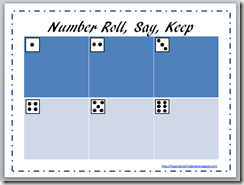
Center 4: Number Top-It and wipe-off number writing books from the Dollar Tree. I made a pretty version of Roll, Say, Keep with all of the directions and cards to print.  Click on the game board on the right to go to the post where you can download it!

P1010088  image

Center 5: I pulled out the foam numbers and the dot cards from the game below to have the kids play as a matching game.  The match the number to the dot cards.  The other game is a puzzle where the match the numeral, number of objects, and number word.

P1010091

We spend about 15 minutes at each rotation. I have thought about using the centers as morning work, but I also like doing 2 centers a day.  I end up with 4 children at a center, and that works well.

I hope someone can use these ideas!  I know that, by putting them on here, I will have a visual of what I did when I plan next year!

Saturday, September 17, 2011

Already?!?

How can I be sick already?!?  I knew there was a stomach bug going around, but I thought I was pretty immune at this point.  No, I didn’t catch the stomach thing, but I do have a horrible sore throat and have been sneezing up a storm.  My throat actually hurt so badly that I woke up at my regular school time on Saturday Sad smile 

What drives me crazy is that I flew through the week and it wasn’t until Friday I started to feel sick. It is amazing how you can keep going until your body slows down a little and then you get hit. I’m sure all of us know how this works!

This week was bizarre!  My kiddos are sweet, but very quiet!  I finally found that science and social studies really spark their interest.  We had a 30 minute conversation about a painting of the signing of the Constitution!  They had questions galore about the time period, and I was in my element as a history lover.  The kids noticed how all of the people were wearing shades of blue and gray and red, so we talked about how stores were different and dyes were made from items in nature.  We talked about powdered wigs and horses versus cars. One of my little ones even talked about how everyone had to garden and hunt for food because they couldn’t go to the store. I think I found my hook this year!

Our wonderful librarian introduced the staff to Pete the Cat, by Eric Litwin.  Now I know many bloggers have featured Pete, but I have to admit that I just didn’t get it until our librarian sang the tune and hooked us up with the author’s website.   In the words of Babbling Abby: Oh.My.Word!  LOVE! 

I am trying like mad to cut down on my school spending, so I ordered one of the books from my public library earlier in the week and it is waiting for me to pick it up now.

  image  image

http://www.ericlitwin.com/

(You can download an MP3 to read the books to the students with the music, rather than trying to sing it yourself – what a saving grace!)

My plan is to use Rocking in My School Shoes as a mapping lesson.  In first grade we teaching map skills and use a school map to teach this skill.  I think Pete will be a great way to kick off this lesson and update it a bit.

As with many other schools/states, we are working on writing curriculum based on the new ELA and Math Common CORE.  I am not naturally a math person, but after writing curriculum, I am excited about expanding my own skills.  Our district just purchased GoMath.  We have never used textbooks – for anything, so to have something so comprehensive is beyond exciting.  I think a few of us even shed tears over this! 

Due to some ordering complications, we don’t have our materials yet and there is a gap between the text and our NYS CORE math.  The text does not necessarily work on counting, number formation, and number recognition for the sake of working on those skills.  However, they are specific state standards, so we decided to spend September teaching these skills.

Nothing is more boring than counting to 100 by 1s. So, I have used some wonderful ideas found in blogland!

1. Harry Kindergarten’s I Can Count to 100 video on YouTube. – My kids are not dancers yet, but some of them are getting in the groove! Harry also has skip counting, days of the week, months of the year and so much more! Now I just need to figure out how to connect to YouTube so that I only get the one video I am looking for.

image

2. Grade ONEderful share a game called Buzz that my class have loved! It is great for practicing counting skills!

image

I am also preparing a bunch of math centers for next week to practice counting and number formation.  I made a Roll, Say, Keep game using number cards for number recognition.  Click on the picture to get your own copy.

image

For number writing practice, I bought a collection of wipe-off books from the Dollar Tree and a center from Scholastic.

Hands-On Learning: Match, Trace and Write Numbers Mats (Scholast... Cover Art     Disney Cars Write-With-Me Numbers Book & CD     Counting 0-31 Wipe Off Book Christian books Image

Sherry Sloan from Kids Count and Jessica Meacham have great counting games and number writing printables  for centers!

Finally, I have printed and am working on laminating games from  Cara Carroll’s Teachers Pay Teachers shop (click the image for the link)zzzzplacevaluepacket[7]

If I can get this all set up, I might actually feel like we have started the year!

Have a great weekend!